Sport in the Outback
You would recognise some familiar sights in the Outback but they perform some tasks with a bit of local flair.
You would recognise some familiar sights in the Outback but they perform some tasks with a bit of local flair.
Well I left you in the previous resoconto with the prospect of the Great Desert Race or, as I found out, it is known in these parts as “The Finke Desert Race”. I surmised that we would be left with a bit of a clean up. Well, I was completely wrong! It is quite a spectacular event and extremely well organised by a standing race committee that “flies” in for the first week in June.
A very steady flow of caravans and pop-up tent campers and a heap of boys my age on motor bikes (not Harleys and tatless – in colourful bike riding gear rather than black leather jackets with tribal names emblazoned on the back) and they are all the most courteous and orderly crew you’ll come across. They camp along the race track between Alice and Finke so it is not so much a huge crowd (they say 25,000 of them) as a huge line stretching the 273 kilometres between the two main communities in NT’s heartland (the geographical centre of Australia is a cairn called Lambert Centre and it sits, alone, in a spot twenty Ks as the crow flies from Finke!)
The race (it’s actually two races – one for buggies and one for trail bikes) runs from Alice to Finke on Sunday, a stay overnight in Finke, and return to Alice on Monday. The races are run rally style – timed events. It has to happen that way because it is conducted on a track that is ONE vehicle wide all the way. The cars go off in two minute intervals and the bikes go off eight at a time in fairly similar intervals.
There are a few crashes. One pour lad lost his life at the Alice end on the first day and another was helicoptered into Finke on the return day and almost immediately flown from Finke directly to the Royal Adelaide Hospital with multiple injuries but apart from these two casualties the medics lining the track and on standby at the Finke clinic had an alert but uneventful two days. I did a tour of Finke and its outskirts at 5pm on the return day and you couldn’t see where everyone had been!
The crowd departs as soon as the last competitors take off from Finke on their return journey producing a bumper-to-bumper line of caravans and semis loaded with race gear that streams down the road to Kulgera en-route to the Stuart Highway – turn right for Alice and Darwin and left to everywhere else. Anyway, now the focus turns to the footy season.
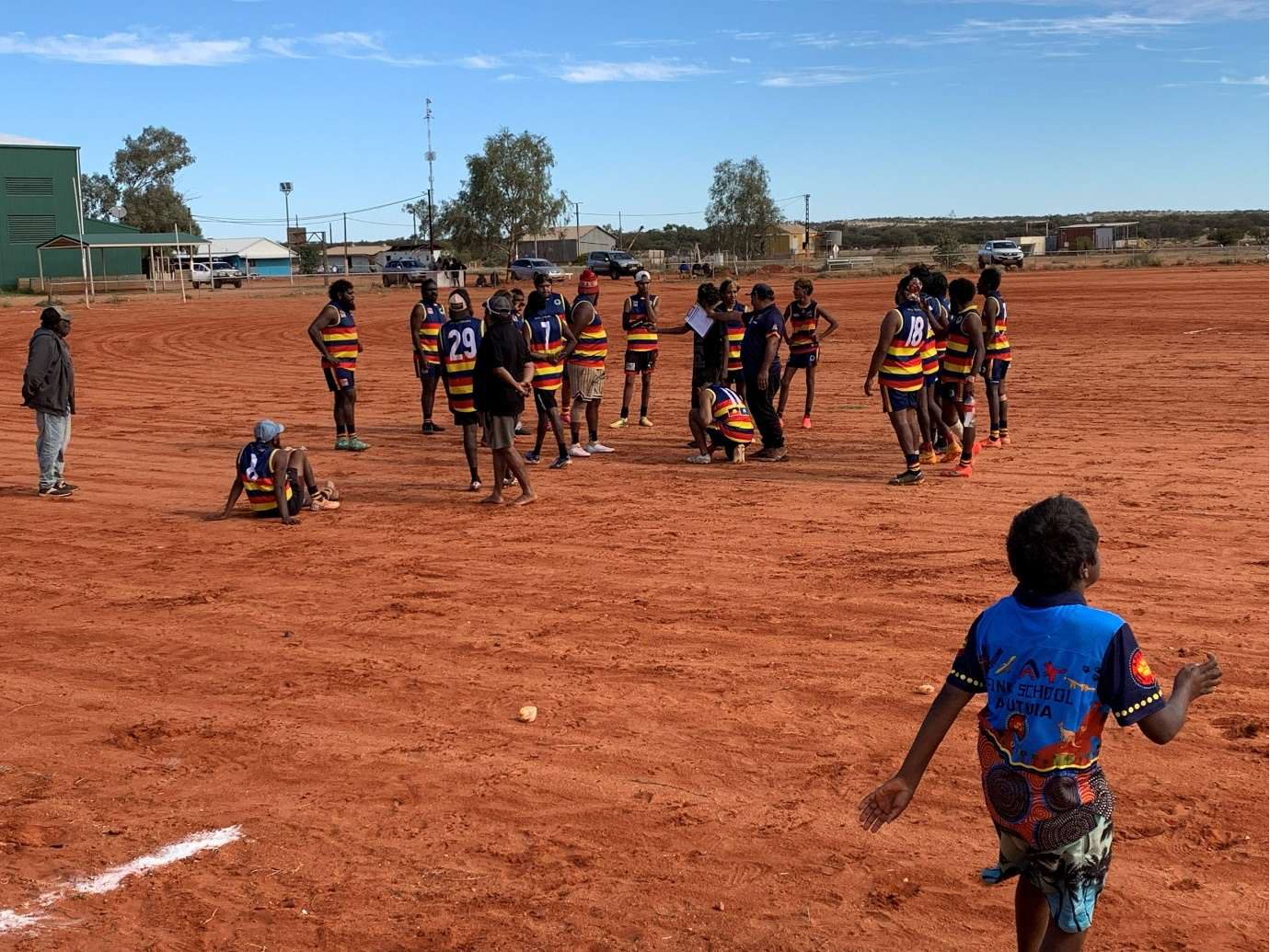
There’s a lot you’d recognise about the game in the Outback, not the least being the local club’s guernsey! Of course it has been “borrowed” from Adelaide’s team in the Australian Football League (the national elite competition) but there are some things that got borrowed FROM the locals because they have been called the Aputula Crows since way before the Adelaide Crows were invented! The lads play interstate matches every week as the rest of the competition hails from across the South Australian border (not very far away) and the Aputula Crows are top of the ladder going for their FOURTH premiership in a row! They were struggling to win games at the start of the season but things picked up when their guernseys arrived four games into the season.
The lads found that the guernseys acted like ball magnets. They had found it a tad difficult to pick out teammates when they were all dressed in different singlets that they had each brought from home.
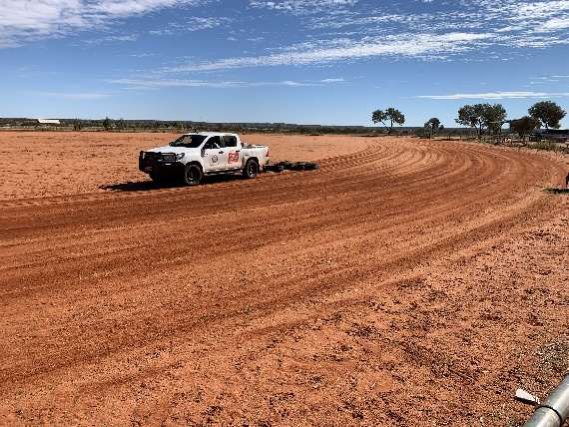
[Aside: the late arrival of the guernseys was due to the fact that they hadn’t gotten around to ordering them until a week before the first game when the current MacDonnell Council Services Coordinator asked the question and, when told of the dilemma, hastily arranged to get the order in and the money to pay for it expedited pronto!] The Council Services Coordinator realised, too, that he was also the Telstradome curator so he arranged to prepare the ground for the first home game by getting the tractor and “mower” cranked up and running rings around the ground. Straightening the goal posts is a future project but interchange benches have been assembled and installed a few day prior to the match.]
All of the game paraphernalia was recognisable with a couple of embellishments. The umpires (yes, two central umpires – one from each team) wore brightly coloured vests to distinguish them from the players and spectators but they retained their long pants. Some of the players couldn’t part with their personal caps and beanies but they all wore footy boots. The odd dog tried to get into the game but failed to get a kick, I suppose because it didn’t wear a guernsey. There weren’t any boundary umpires but the game didn’t suffer. The boundary line on the grandstand side was installed by the Crow’s coach just before the start of play by springling Woolies brand plain flour (and he did a marvellous job given that a boundary line follows a curved, not a straight line). The two goal squares and centre square got similar treatment but the flour ran out before the “outer” boundary was laid but, as it transpired, it wasn’t at all necessary as the ball did not venture out that far as both teams appeared to have a silent agreement to keep play on the grandstand side. The play, as one should expect, was pretty to watch. We all get a special thrill out of watching the crafty exhibitions of indigenous players so just imagine a game in which EVERY player shows that quality of skill. The umpires had nothing to do except blow the whistle for the marks. The players all play the ball so there are is absolutely no need for whistleblowers to interrupt the flow of the game because every player is out there to do exactly that – to get the ball and keep it moving. It is a game that is totally about skill. Lots of excellent marking, heaps of play-on football, baulking, dashes around the flanks and continual movement of the ball. No need for trainers either because there are no body clashes. There is tackling but the ball keeps moving so why stop the play with a whistle? I have spent a great amount of time in the earlier part of my life in a tireless effort to explain this to football umpires! Anyhow, great sporting entertainment played in excellent spirit by the players and the spectators. That is exactly what sport is about and it is alive and doing well in the Outback.
Bryan Forby
Finke