Sixty days in Umbria Primo parte
Umbria is a region wedged between Lazio, Marche and Toscana immediately north and north-east of Rome.
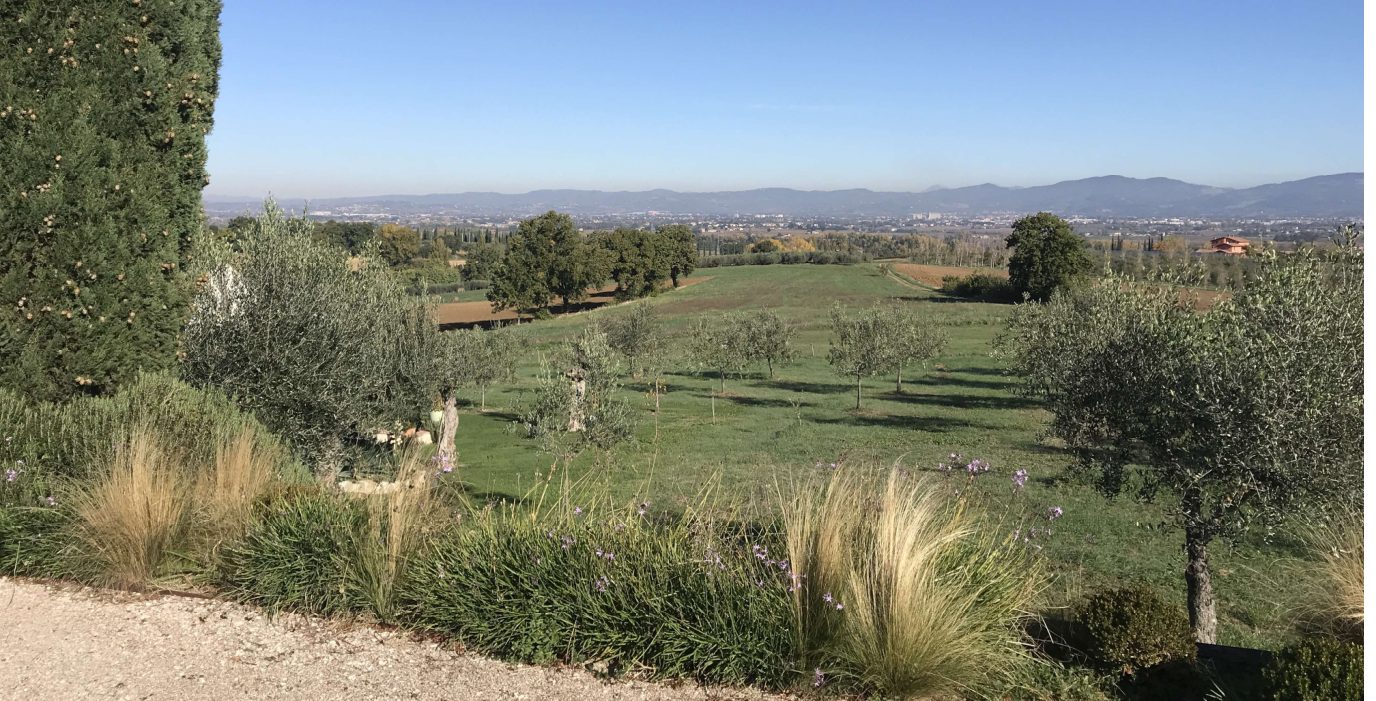
Umbria is a region wedged between Lazio, Marche and Toscana immediately north and north-east of Rome. It is essentially an agricultural region producing, along with many other regions, olive oil, vino and the produce of the land. There are endless vistas of rolling green hills sprinkled with charming, attractive, two-storey farmhouses built of local sandstone. The landscape is most attractive and very productive.
The region was historically the homeland of the Etruscans who occupied the lands for a thousand years prior to the “arrival” of the Romans. They were probably the first group of people who came under the domination of the Romans about five hundred years prior to the birth of Christ.
Bettona
Cinzia and I are staying in a brand new apartment, built in the same style as the building it replaced right, smack-bang in the middle of the centro of a tiny borgo (that is the term for a small village) perched on the peak of the highest hill in the district. The borgo is diminutive. It is a cluster of three storey apartments snuggling together around a piazza which is the home to the bar, two restaurants, the municipio offices and four churches. Obviously, in this part of the world, being very close to God is more important than anything else. You have to snake your way five metres down the hill to buy the essential goods that sustain life. There is another borgo at the foot of the hill but it doesn’t even have a bar, or council offices and has only one tiny chiesa.
Bettona was originally established by the Etruscans as a watchtower over the surrounding countryside. Its position and vista were so ideal that the Etruscans bent one of their very important rules – it is the ONLY Etruscan outpost situated on the left bank of the Tiber (the river that runs all the way to and through Rome). They had a hard-and-fast rule that they only occupied the right banks of rivers.
Those original Etruscan structures have long gone (they did not possess the building technology of the Romans) but their buildings and battlements were replaced in the Middle Ages (using Roman technology) and hence the watchtower borgo appears pretty much as it has for almost three thousand years.
I have driven a station wagon (a huge car by Italiano standards), the trusty Peugeot 307 (the model is called “The Australian” because it was built to tackle the rigours of the Ozzie outback – not the ancient villages of the Italian hilltops where the roads were built for horses and later chariots) in some fairly challenging situations.
I have driven through the heart of the centro storico in Velletri and Cori (which, like Bettona, precede Rome’s establishment by seven hundred years) which required a great deal of dexterity, often scraping BOTH wing mirrors through the narrowest sections but my dexterity was raised to a brand new level when I negotiated the path to drop off our gear in the apartment at Bettona!
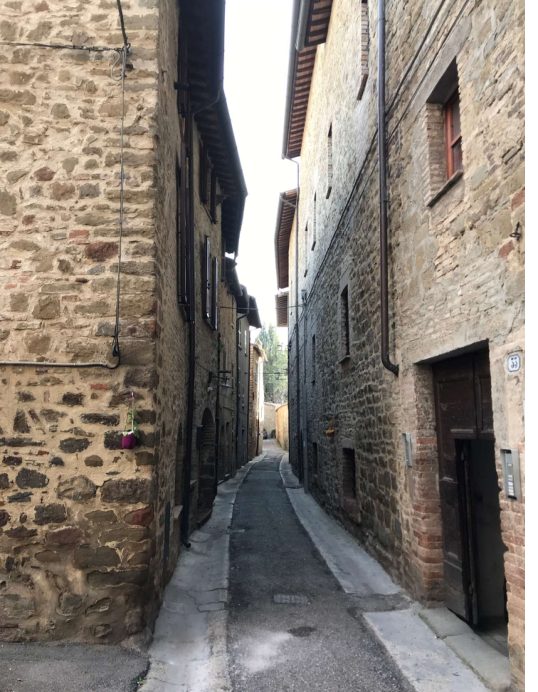
All roadways at Bettona are one-way and the ”main” streets (leading to and from the piazza) are just wide enough to accommodate the majority of vehicles BUT wait till you tackle the minor side roads! Most are only two donkeys wide so, clearly, they are only negotiable on foot (or a donkey if you have one) but there are a few tracks that fall somewhere between the two-donkey and the chariot wide passages and I found one of these when dropping off the suitcases.
I noticed that there were two vehicles that had inserted themselves in what I regarded as an inaccessible spot not far from the gateway to our unit and, of course, I thought: “If they can do it why can’t I?” I didn’t pay that much attention to the fact that one was a Fiat Pinto and the other was one of those three-wheeled short and very skinny “motorbikes with a tray-top” jobs that are fairly popular in these parts. Well I successfully got my car, after quite a bit of “forward 400 millimetres, back 400 millimetres, forward …, back … “ manoeuvres to a spot where I could unload but the real fun started when I was trying to extract the car and return it to the roads that were negotiable with a single pair of underpants. Now these laneways are reasonably straight with an occasional deflection here and there but this one had two concealed variations that were to present an occasion that was to exhaust my wardrobe of underwear.
While it was obvious that there would be very little margins for the full length of the journey (about two-hundred metres) what was not so obvious was that the deviations nicely hid the fact that the bloody lane was actually funnel shaped – it gradually reduced its width along the way! The other hidden feature was that there were TWO ninety-degree bends – one sinistra and the other destra. Negotiating ninety-degree bends when BOTH roads are barely wide enough for the vehicle AND the vehicle is a tad wider and longer than the motorbike with a tray-top, presents one of life’s great learning situations.
After closing the two wing mirrors, closing my eyes, praying and bracing myself I seemed to get past the “funnel” sections but when I got to the final right- hander and was confronted by what appeared at first sight to be a solid stone wall I had to call Cinzia and have her go through the suitcases looking for a clean pair of pants.
It took about six shunts moving 300 millimetres with each move to finally get that huge machine around such a tiny bend. When I made a close inspection of the vehicle on all sides I was amazed to find that there were no new alterations to the panels and the paintwork, despite the fact that I heard a number of scraping sounds during the ordeal. I am sure that I can lay claim to being the first person in three thousand years to get a station wagon built to Australian standards around that bend! Well, isn’t that what life is about? Coming up against impassable obstacles and coming out the other end breathing, with a heart-beat and hopefully only minor scratches.
Assisi
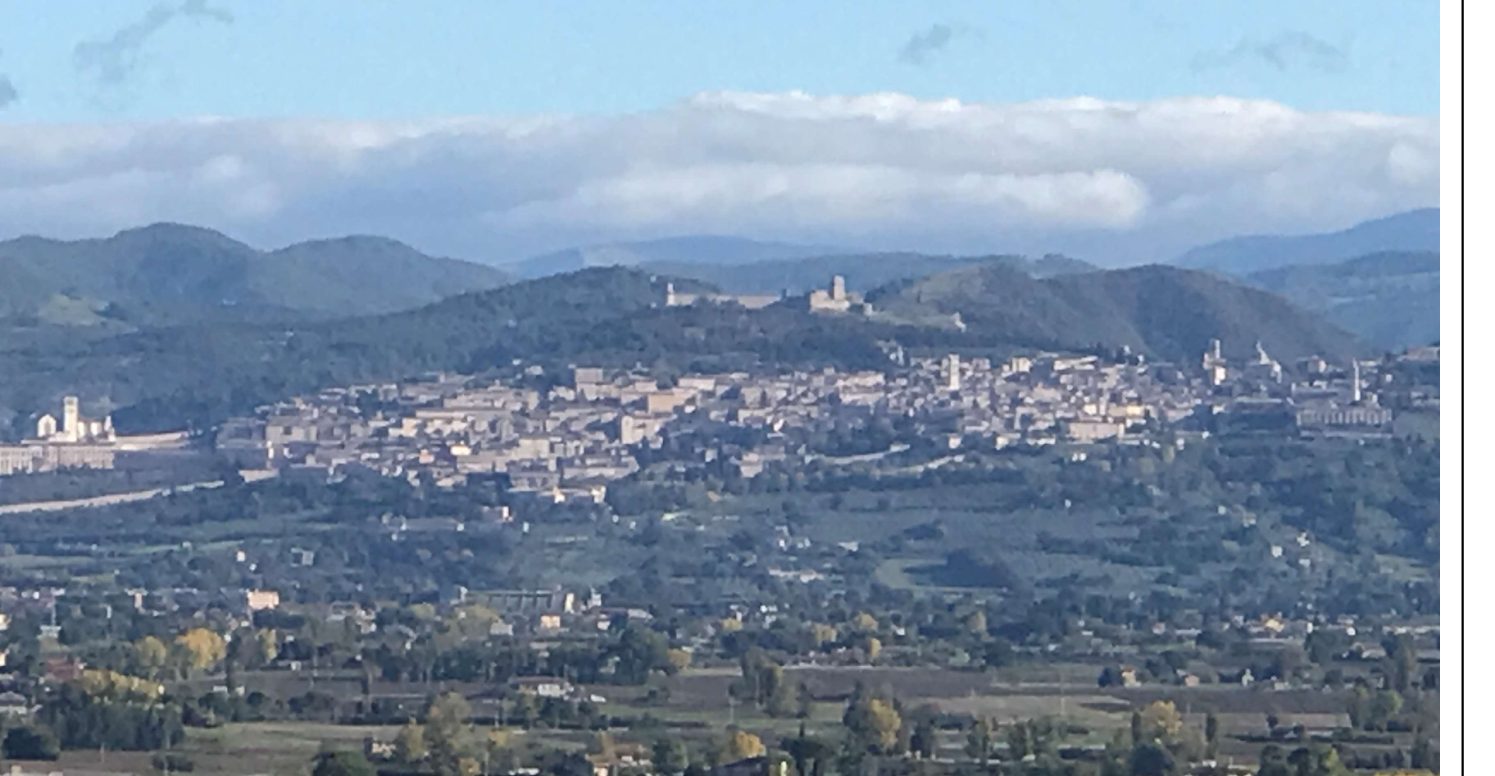
Assisi has been made famous by the exploits of one of Christianity’s most revered saints who was canonised in 1228 by the Roman Catholic Church. St Francis was born into a very wealthy family and became the archetype party- playboy and extraverted rich-kid who would have absolutely loved rock-n-roll had it been invented. At age twenty he clad himself in armour and became a knight fighting to save Assisi from the marauding neighbours in Perugia. Alas, he was taken prisoner and spent a year with a different lifestyle before plunging into poor health and having visions of heavenliness, whereupon he devoted himself to the service of the Church.
He renounced his wealth and all earthly possessions and took to wearing a very basic tunic with sandals and spent his time evangelising amongst lepers, the poor and the destitute. He was the founder of the Order of the Friars Minor which became known universally as the Franciscans. The Franciscans had no possessions and no church and went about Umbria and Italy preaching to the poor. Francis helped to rebuild a couple of churches, one of which is a tiny chapel that survives to this day, protected by a much grander basilica at the foot of the hill upon which Assisi stands. Assisi has become famous as a result of the work of St Francis. While it is his birthplace and resting place Francis did most of his preaching in the area
immediately around Assisi. It is a “must see” location on the religious pilgrimage route. In the usual fashion the body parts of departed saints seem to get distributed far and wide but most of Francis’s remains (officially known as “relics”) are encased in a bronze casket mounted on a pier of grey stones in the Basilica of St Francis of Assisi, high on the hill at Assisi which is a mecca for the seriously religious.
The Assisi centro is more like a peak than anything else. It is a long but not overtaxing climb from St Francis to the top of a very well maintained medieval town. There are two types of commerce – eaterias and shops selling Franciscan artifacts and fridge magnets. Our fridge is on the mid size rather than large and we have been to a lot of places so we spent our time and euro on food.
Santa Maria degli Angeli
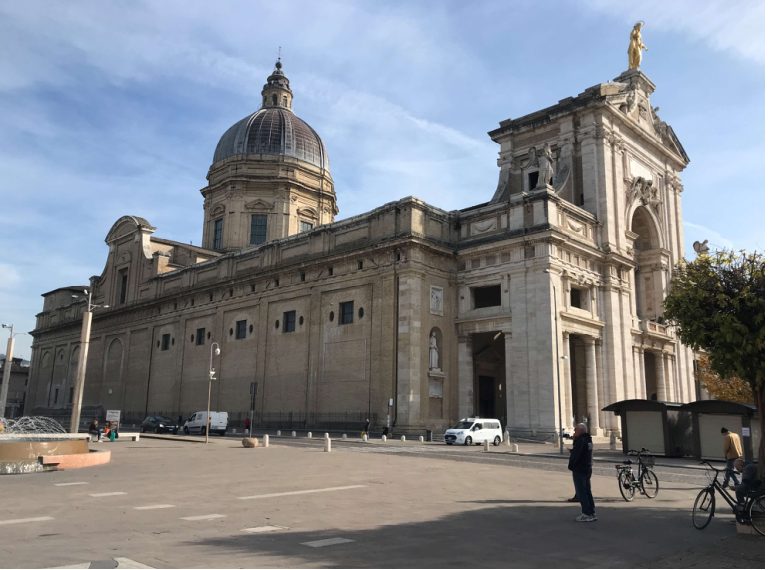
Lying at the foot of Assisi is the small town of Santa Maria degli Angeli which is where St Francis did most of his work, part of which involved restoring a tiny chapel which had fallen into disrepair. Today that tiny restored chapel (named the Porziuncola) is very well preserved – nestled into the bosom of the Basilica Santa Maria degli Angeli. St Francis passed away in this chapel where he had performed most of his preaching.
Saint Francis went about rebuilding and refurbishing the tiny chapel in the very early 1200s and the Vatican authorised the construction of the basilica as a protective shroud for the chapel in 1569. Construction took place over the next one hundred and ten years. An earthquake in 1832 caused serious damage to the basilica but the structure was reinstated.
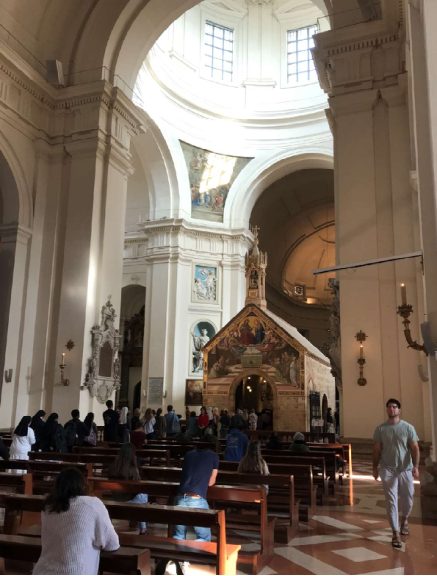
There are numerus interesting facts that arise from this story. The reverence shown St Francis over the centuries is amazing. There is no more revered figure in the history of the Catholic church and his legendary status grew purely and simply from the example St Francis set by his actions.
He was an extremely humble man whose personal sacrifices and whose work amongst the poor battlers of his tiny parish, working out of a diminutive chapel (which, in current times, with COVID social distancing practices, would accommodate a congregation of less than ten) has inspired people around the world to make pilgrimages by the bus-load to a small rural town in the Umbrian countryside for almost a thousand years.
Bryan Forby
Umbria